




Disclaimer: All information contained herein should be independently verified by the reader and not be relied upon without such verification. An automated external defibrillator is a medical device and should only be used according to the manufacturer’s instructions. Sudden cardiac arrest is a medical occurrence, and appropriate medical advice should be sought. Always dial Triple Zero in an emergency.
At a glance
- CPR and an AED are not interchangeable; they address different problems during cardiac arrest.
- CPR keeps oxygenated blood moving while the AED is retrieved, turned on and applied.
- An AED analyses the heart rhythm and delivers a shock only when a shockable rhythm is detected.
- CPR should pause only when the AED instructs responders to stand clear, then resume immediately.
Most people know that cardiopulmonary resuscitation (CPR) and an automated external defibrillator (AED) are important interventions during sudden cardiac arrest. What is less understood is that the two are not interchangeable; starting compressions is not a substitute for defibrillation, and using an AED does not remove the need for CPR.
Cardiac arrest creates two separate problems at once: the heart’s electrical system may enter a chaotic, disorganised rhythm, and it stops circulating blood effectively. CPR and AED each address one of those problems, and neither can address both.
This article explains what each intervention does in a cardiac emergency and why the two are most effective when used together.
What CPR Does in a Cardiac Emergency
When someone experiences cardiac arrest, the heart can no longer pump blood effectively to the brain and vital organs. CPR manually maintains circulation through chest compressions, slowing the rate at which damage can occur.
It is also important to understand what CPR does not do. It does not correct the underlying electrical problem that caused the arrest. In many cases, the heart is caught in a chaotic, disorganised rhythm that prevents it from beating and pumping blood properly. CPR cannot resolve that. What it can do is buy time.
The sooner CPR begins, the better the conditions for defibrillation to work. CPR keeps oxygenated blood moving to the heart and brain, which helps maintain the viability of a shock. Without it, that window closes quickly. CPR is not the complete solution, but it is what keeps defibrillation a possibility.
What an AED Does During Cardiac Arrest
While CPR keeps blood circulating, an AED addresses the rhythm problem CPR cannot fix. Many cardiac arrests involve ventricular fibrillation, where the heart’s lower chambers quiver rapidly instead of pumping blood effectively. A controlled shock from an AED can interrupt that abnormal activity and allow the heart to return to a more organised rhythm.
Before any shock is delivered, the device analyses the heart’s electrical activity. It only advises or delivers a shock when a shockable rhythm is detected, which is what makes modern AEDs safe for people without medical training.
It is also important to know what defibrillation does not do. An AED does not restart a heart that has completely stopped. It is designed to correct chaotic electrical activity so the heart can beat normally again.
Ambulance Victoria’s most recent cardiac arrest report shows why early access matters. Patients first shocked by a public AED before paramedics arrived had a survival rate of around 63%, compared to around 7% when there was no CPR or AED intervention [1].
How CPR and an AED Work as a Team
Once the role of each intervention is clear, the response becomes simple: CPR starts immediately, and the AED is applied as soon as it is available.
When someone collapses from cardiac arrest, the response follows a clear order:
- Call Triple Zero (000) immediately.
- Begin CPR without delay.
- If others are present, ask someone to retrieve the nearest AED. If you are alone, retrieve the AED yourself as soon as possible. Pause CPR only long enough to get it.
- Turn on the AED and apply the pads as directed.
- Follow the device prompts while it analyses the heart rhythm.
- Pause CPR only when instructed to stand clear for analysis or shock delivery.
- Resume CPR immediately when prompted and continue until emergency services arrive.
Do not delay CPR while someone retrieves the AED, and do not rely on CPR alone if an AED is available.
Ambulance Victoria notes that when a patient receives both CPR and an AED shock before paramedics arrive, their chance of survival more than doubles [2]. Neither intervention creates that outcome alone. The benefit comes from using them together, in the right order.
Why AED Access Outside a Hospital is Important
Knowing how CPR and an AED work together is only useful if an AED is within reach. For most cardiac arrests, that is not guaranteed.
According to data from the Australasian Resuscitation Outcomes Consortium (Aus-ROC), 76% of cardiac arrests in Australia occur in private residences, while only around 2% of them receive defibrillation from a bystander before paramedics arrive [3]. That gap exists because most cardiac arrests happen somewhere without access to a public AED. CPR can begin wherever a bystander is present. Defibrillation depends on whether an AED is within reach.
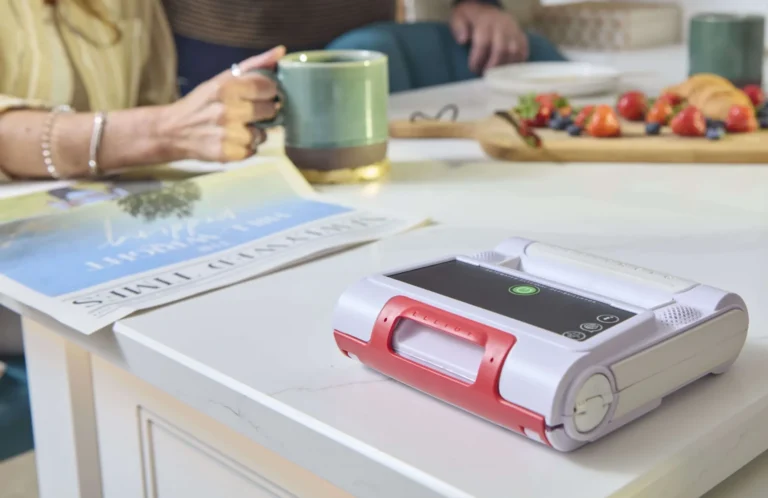
This is where access to a portable defibrillator becomes relevant. Elliot AED is designed for everyday environments such as homes, cars, workplaces and travel. It is a fully automatic defibrillator, meaning once the pads are placed, it can analyse the heart rhythm and deliver a shock when required, without the responder needing to press a shock button. Clear voice and visual guidance, along with adult and child modes, help support use in high-pressure situations.
Elliot also supports long-term readiness through Bluetooth® and LTE connectivity, battery and pad status monitoring, automatic daily self-checks and monthly functional tests with alerts for faults. It is listed on the Therapeutic Goods Administration’s Australian Register of Therapeutic Goods (ARTG), helping ensure it meets Australian safety and performance requirements.
Order your Elliot AED and be prepared before a cardiac emergency occurs.
FAQs
Why do sudden cardiac arrests happen?
Sudden cardiac arrest occurs when the heart’s electrical system malfunctions, causing the heart to stop pumping blood effectively. It can happen without warning and may be linked to underlying heart disease (including inherited heart conditions), trauma or other medical causes. To learn more about what causes sudden cardiac arrest and how it differs from a heart attack, read our guide on why sudden cardiac arrests happen.
What if only one person is present during the emergency? What should they do?
If you are alone with someone unresponsive and not breathing normally, call Triple Zero (000) immediately and use your phone’s speaker function so you can start CPR while speaking with the call taker. If an AED is nearby and can be retrieved quickly, pause the CPR and retrieve it as soon as possible and follow its prompts. If no AED is within reach, continue CPR until emergency services arrive or someone else can bring one.
How do you use an automated external defibrillator on children?
For children, use the child or paediatric mode if available, as pad placement and shock energy can differ from those for adults. Elliot includes a dedicated child button that adjusts prompts and reduces shock energy when selected before the pads are applied. For detailed steps, read our guide on using an AED.
Citation
- Ambulance Victoria – Ambulance Victoria Initiatives Boost Cardiac Arrest Survival Rates https://www.ambulance.vic.gov.au/ambulance-victoria-initiatives-boost-cardiac-arrest-survival-rates
- Ambulance Victoria – Victorians Save Lives One Shock At A Time https://www.ambulance.vic.gov.au/victorians-save-lives-one-shock-at-a-time
- Aus-ROC – Out-of-Hospital Cardiac Arrest: Australia and New Zealand https://www.sciencedirect.com/science/article/abs/pii/S0300957222000120