




Disclaimer: All information contained herein should be independently verified by the reader and not be relied upon without such verification. An automated external defibrillator is a medical device and should only be used according to the manufacturer’s instructions. Sudden cardiac arrest is a medical occurrence, and appropriate medical advice should be sought. Always dial Triple Zero in an emergency.
Yes, an AED can be a thoughtful and practical gift for the right person or household. It gives the people you care about greater access to emergency equipment in the event of sudden cardiac arrest.
That access can be especially valuable at home. Around 76% of out-of-hospital cardiac arrests in Australia and New Zealand occur in private residences, yet only around 2% of these cases receive public defibrillation before emergency services arrive. [1] Among patients first shocked by a public AED, 63% survived to hospital discharge. [2] For every minute defibrillation is delayed, the chance of survival is estimated to decrease by around 10%. [3]
An Automated External Defibrillator can also be practical for everyday households because it is designed for straightforward emergency use. A person does not need formal medical training to use one, as voice and visual prompts guide the responder while the device analyses the heart rhythm and determines whether a shock is required. Familiarisation and first aid training can still help build confidence.
Because sudden cardiac arrest can occur to anyone unexpectedly, an AED isn’t only for one type of household. This article looks at who could benefit from receiving one as a gift.
Parents or Grandparents Who Spend a Lot of Time at Home
For parents or grandparents who spend much of their time at home, an AED can be a practical addition to household emergency equipment. Cardiovascular conditions become more common with age, although age alone does not mean someone will experience sudden cardiac arrest.
A home defibrillator gives a spouse, adult child, carer, neighbour or visitor access to defibrillation equipment without needing to leave the property to locate a public AED. This can be particularly relevant for older couples or parents living independently, while also giving any visiting family members or carers access to the same device.
An AED is used for suspected sudden cardiac arrest when a person is unresponsive and not breathing normally. For more on what happens once the device is activated, read What Is an Automated External Defibrillator and How Does It Actually Work?
A Household Where Someone Has a Known Heart Condition or Family History
Some households may already have a stronger reason to think about cardiac emergency preparedness. Coronary artery disease, cardiomyopathy, previous heart attack and certain inherited rhythm disorders can increase the risk of sudden cardiac arrest. A family history of heart conditions may also indicate increased risk.
An AED does not replace medical treatment, prescribed medication or advice from a healthcare professional. It serves a different purpose in the event of sudden cardiac arrest: providing access to defibrillation. The device is also not limited to the person with the known condition. If another family member or visitor experiences sudden cardiac arrest, the same AED may potentially be used.
Families With Children or Several Generations Under One Roof
A multigenerational household may include children, parents, grandparents and regular visitors. In that setting, gifting an AED to one person can effectively provide the whole household with access to the equipment.
Not all AEDs work the same way for adults and children, so paediatric capability is worth considering when the device may need to serve people of different ages. That allows one device to support both adult and paediatric emergencies without requiring the household to keep separate AEDs for different age groups.
People Who Travel, Camp, Boat or Spend Time Outdoors
People who regularly travel, camp, boat or spend time outdoors may not always be close to a publicly accessible AED. Road trips, caravanning, hiking and stays at holiday properties can all take people further from the fixed defibrillators commonly available in busy public spaces.
For someone who spends a lot of time away from these locations, having a portable defibrillator packed with their emergency kit can reduce reliance on finding a public device nearby if sudden cardiac arrest occurs.
Carrying an AED does not replace calling Triple Zero (000) or performing CPR. It simply provides closer access to defibrillation when travelling or spending time in places where a public AED may not be readily available.
Loved Ones Living in Regional or Remote Areas
Location can also influence how practical an AED gift may be.
Someone living on a regional property, farm or in a more remote community may be some distance from a hospital, ambulance station or publicly accessible AED. Even where a public device is available, the important question is how quickly someone could actually reach it during an emergency.
Keeping an AED at the property removes that travel time. In a regional or remote area, emergency services may take longer to arrive, and having the device already on hand means no one has to leave to find one during that wait.
An AED is only one part of the response. If someone is unresponsive and not breathing normally, Triple Zero (000) should be called, CPR should begin and the AED should be used as soon as it is available. Having the device nearby simply reduces one potential delay in that process.
An AED can be a thoughtful gift for individuals and households where having defibrillation close by could strengthen emergency preparedness. That may include ageing parents, multigenerational families, households with known cardiac risk factors, frequent travellers and people living further from public AED access.
The value lies in having the right equipment available if sudden cardiac arrest occurs, while still calling Triple Zero (000), starting CPR and following emergency instructions.
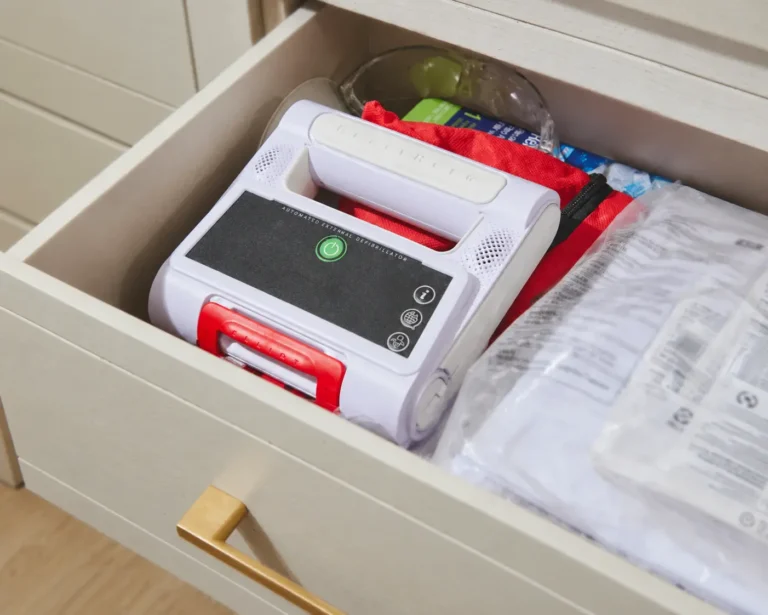
Elliot AED is a portable, lightweight AED listed on the TGA’s ARTG. It features fully automatic operation, clear voice and visual prompts, pre-connected pads and dedicated adult and child modes. Elliot also performs automatic self-tests and provides battery, pad and device status alerts to support long-term ownership.
FAQs
Is an AED a good gift for someone with no known heart condition?
Yes. Sudden cardiac arrest can happen unexpectedly, including in people without a previously diagnosed heart condition. An AED does not need to be purchased exclusively for someone considered high risk. It can be part of broader household emergency preparedness and can be used for family members, visitors and the person receiving it as a gift.
Does an AED need maintenance if it has never been used?
Yes. AED batteries and electrode pads have service lives and need to be replaced when required, even if the device has never been used in an emergency. Elliot performs regular self-tests and provides alerts on battery, pad and device status so owners can identify when attention is required.
Can one AED be used for both adults and children?
It depends on the device. Some AEDs require separate paediatric pads or accessories, while others provide a dedicated child mode. Elliot includes adult and child modes in the same device. Selecting child mode before applying the pads reduces the shock energy and changes the pad-placement guidance for paediatric use.
What should you look for when buying an AED as a gift?
Look for an AED that is listed on the TGA’s Australian Register of Therapeutic Goods (ARTG), is straightforward to use and suits the recipient’s household or lifestyle. Useful features include clear voice and visual prompts, fully automatic operation, adult and child capability, a compact and lightweight design, automatic self-tests and alerts for battery or pad issues. It is also worth checking how easily replacement batteries and pads can be obtained to keep the device useful over the long term.
Citations
- ScienceDirect – Out-of-Hospital Cardiac Arrest: Australia and New Zealand (Aus-ROC report): https://www.sciencedirect.com/science/article/abs/pii/S0300957222000120
- Ambulance Victoria – Victorian Ambulance Cardiac Arrest Registry Annual Report 2024/25: https://www.ambulance.vic.gov.au/sites/default/files/2026-03/VACAR-Annual-Report-2024-2025.pdf
- ScienceDirect – Decreasing the time of defibrillation (research paper): https://www.sciencedirect.com/science/article/abs/pii/S0196064404009400