




Disclaimer: All information contained herein should be independently verified by the reader and not be relied upon without such verification. An automated external defibrillator is a medical device and should only be used according to the manufacturer’s instructions. Sudden cardiac arrest is a medical occurrence, and appropriate medical advice should be sought. Always dial Triple Zero in an emergency.
Automated external defibrillators (AEDs) are commonly found in airports, shopping centres, workplaces and other public locations, but compact and more affordable models have made personal and small-scale ownership more practical.
A small, lightweight AED is easier to store, carry and keep accessible at home, at work or while travelling. Affordability can also make ownership more achievable for households, small businesses, sporting clubs and community organisations with limited budgets.
This article looks at five practical use cases of a small, affordable AED, for home and travel to workplaces, community activities and remote destinations.
Keeping an AED at Home
A home AED provides immediate access to defibrillation equipment rather than relying entirely on a nearby public-access device. If sudden cardiac arrest occurs at home, leaving the property to locate an AED can add time and take a responder away from the person who needs help.
A compact device can be kept in a known, accessible location without taking up much space. The priority is for household members to know where it is and be able to retrieve it quickly.
An affordable model can also make home AED ownership a realistic option for households that may otherwise rely on public-access devices. For families considering this option, our guide on whether every Australian home should have an AED takes a closer look at home AED ownership.
Taking an AED While Travelling, Camping or Spending Time Outdoors
Road trips, camping, caravanning, hiking, boating and other outdoor activities can take people away from familiar public AED locations.
A portable automated external defibrillator can be packed with other emergency and first-aid equipment rather than remain at a fixed location. A lighter, more compact AED is especially practical when the device needs to fit into a vehicle, caravan, boat or travel alongside other gear.
For people who regularly spend time outdoors, portability can make it more practical to keep an AED nearby rather than depending on finding a public device at each destination.
Providing AED Access in Small Businesses and Workplaces
Small offices, retail premises, workshops and service businesses may also consider keeping an AED on site for employees, customers, contractors and visitors.
For a smaller business, space and budget can influence whether owning an AED is practical. A compact unit can sit in an accessible location without taking up much storage space, while a lower purchase price can bring on-site access within reach for businesses with tighter budgets.
Ongoing upkeep is another practical consideration. An AED that makes battery, pad and device status easy to monitor can reduce the administrative effort required to keep it ready for use.
Read More: Does Your Workplace Need an AED?
Carrying an AED Between Sporting Activities, Community Events and Venues
Sporting clubs and community groups often operate across different fields, courts and venues, while competitions, tournaments, markets, fundraisers and school fetes may take place away from a main facility.
An AED may be available at a clubhouse or central location, but it may not be reachable quickly. During sudden cardiac arrest, rapid access to defibrillation is critical, so keeping an AED closer to the activity can reduce retrieval time.
A lightweight AED can be carried with other first aid and emergency equipment, making it practical for smaller clubs and community organisations that do not have a device available at every venue or activity area.
Housing an AED at Remote Holiday Properties and Isolated Destinations
Holiday houses, remote cabins, rural retreats and other isolated destinations can be some distance from publicly accessible AEDs. In these settings, distance changes the calculation. Reaching the nearest AED and returning can take considerable time, even if one exists somewhere in the wider area.
Keeping an AED at these properties means the equipment is already on site if sudden cardiac arrest occurs. Unlike an AED carried while travelling, the device can remain at the property as part of its emergency equipment.
Compact size is useful where storage space is limited, while affordability can make it more practical to keep a dedicated AED at a secondary or remote property.
Small, affordable AEDs can make defibrillation equipment practical in settings where space, portability or budget may otherwise be a barrier. Whatever the setting, the AED should be easy to locate, ready to use and work alongside calling Triple Zero (000) and performing CPR during a suspected sudden cardiac arrest.
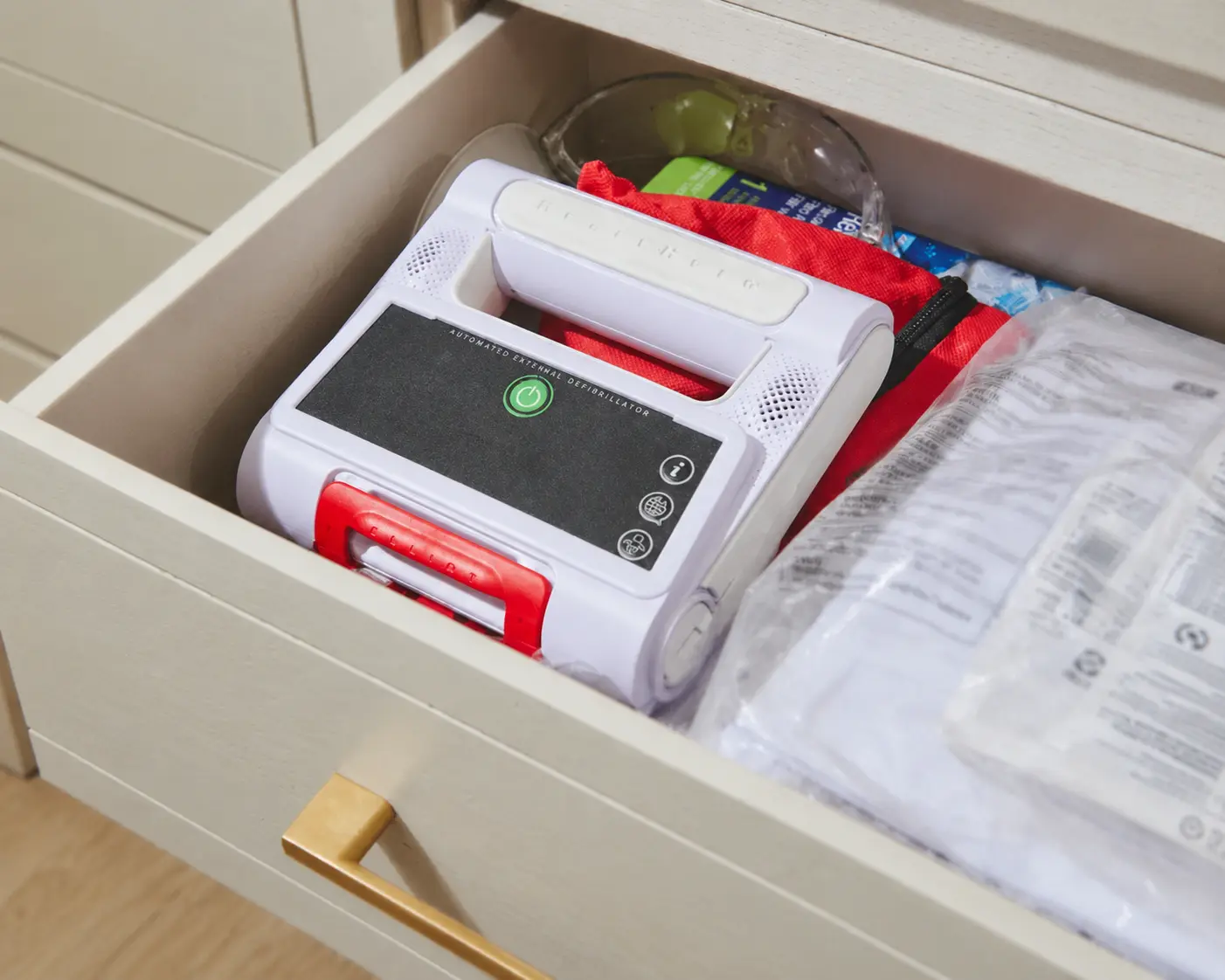
Elliot is a compact, lightweight and fully automatic AED designed for everyday environments. It offers voice and visual guidance, adult and child modes and device-readiness monitoring to help owners keep track of battery and pad status over time.
Explore Elliot AED to see how a portable AED could fit into your emergency preparedness.
FAQs
How Often Should an AED Be Checked If It Has Not Been Used?
An AED should still be checked periodically even if it has never been used. This includes confirming that the device’s readiness indicator is functioning, verifying the battery condition and making sure the pads have not expired or been damaged. Elliot AED performs daily battery and pad checks and a full functional test monthly, with alerts if the device needs attention.
What Ongoing Costs Come With Owning an AED?
The main ongoing costs are replacement batteries and electrode pads. Elliot uses four standard Duracell CR123A batteries, which are readily available to purchase and replace. Its electrode pads are single-use, have a five-year shelf life and must be replaced after use or when they reach their expiry date. Replacement pad cartridges are available separately.
Does a Portable AED Need to Be Plugged In or Recharged?
It depends on the AED model. Some use proprietary battery packs, while others use standard, off-the-shelf batteries. Elliot does not require external power or charging. It runs on four non-rechargeable Duracell CR123A batteries, so the device stays ready without being connected to a power outlet.