




Disclaimer: All information contained herein should be independently verified by the reader and not be relied upon without such verification. An automated external defibrillator is a medical device and should only be used according to the manufacturer’s instructions. Sudden cardiac arrest is a medical occurrence, and appropriate medical advice should be sought. Always dial Triple Zero in an emergency.
At a glance
- There is no single national law requiring every Australian gym to have an AED, although South Australia has specific public-access AED legislation.
- AED provision in other jurisdictions is generally considered through Work Health and Safety obligations and risk-based first aid arrangements.
- A gym AED should be easy to locate, quick to retrieve, clearly signed and accessible whenever the facility is open.
- Regular checks, clear emergency procedures and staff familiarity help ensure the device is ready when needed.
Gyms and fitness centres bring together people of different ages, fitness levels and health backgrounds. Although sudden cardiac arrest during exercise is uncommon, it can occur without warning, including in people with no known heart condition. Sudden cardiac arrest requires an immediate response (CPR and defibrillation as soon as possible), which is why gyms need to think about AED access as part of their emergency planning.
In a fitness setting, access is as important as ownership. An AED that isn’t within easy reach of the workout floor may not be fast enough to use when it’s needed. A portable defibrillator should therefore be positioned where staff or members can reach it quickly. It does not replace CPR or emergency services, but it can analyse the heart rhythm and deliver a shock when required.
This article covers the regulations and duty-of-care considerations, practical steps for improving cardiac readiness, and the features to look for when choosing an AED for a gym.
Regulations and Duty of Care
There is no single national law requiring every Australian gym or fitness centre to have an AED. Requirements depend on the jurisdiction and whether specific state legislation applies. Even where an AED is not mandatory, fitness centres should ensure their first aid arrangements reflect the realities of the space: high member turnover, physically demanding activity and the time it would take staff to reach someone on a busy training floor.
South Australian Requirements
South Australia is currently the only Australian jurisdiction with dedicated public-access AED legislation. The Automated External Defibrillators (Public Access) Act 2022 [1] applies to certain public buildings, sporting facilities and commercial premises, depending on factors such as building use, floor area and public accessibility. The Act commenced for Crown-owned buildings from 1 January 2025, and has applied to non-Crown buildings (including most privately owned gyms) from 1 January 2026, meaning it is now in force for the majority of fitness centres. [2]
Where the Act applies, obligations may include maintaining the AED in accordance with the manufacturer’s instructions, installing prescribed signage and registering the device. A relevant building under the Act is generally one with a floor area of 600m² or more, with additional AEDs potentially required above 1,200m² on commercial land. [2] Gym owners should confirm whether their premises are covered under the current Act and regulations.
Other Australian States and Territories
Outside South Australia, requirements vary. In many jurisdictions, AED provision is addressed through Work Health and Safety obligations and risk-based first aid arrangements rather than legislation requiring every gym to install one.
Safe Work Australia’s First Aid in the Workplace Model Code of Practice [3] recommends considering an AED where ambulance arrival may be delayed or large numbers of the public are present. It also advises that any AED provided should be visible, accessible, clearly signed and maintained according to the manufacturer’s instructions.
A fitness centre’s first aid arrangements should reflect its hazards, size, location and the mix of members, visitors and staff who use it. Operators should check the legislation and guidance that apply in their state or territory, as the model Code only has legal effect where it has been adopted.
Beyond Compliance: Building Cardiac Readiness in Your Fitness Centre
Installing an AED is only one part of emergency preparedness. The device also needs to be properly positioned, well maintained and backed by staff who know how to use it. For fitness centres, this means considering how the AED fits into the facility’s daily operations, not just where it is mounted.
Placement and Retrieval Time
Position the AED where it can be reached quickly from the main workout areas. Reception may be suitable in a smaller gym, but larger facilities should consider the distance from cardio zones, weights areas, studios, pools and outdoor training spaces.
For gyms operating within a shopping centre, sports complex or shared commercial building, relying on an AED located elsewhere in the property can delay the emergency response. Multi-level or divided facilities should also assess whether one device provides practical coverage across the entire site.
Accessibility and Signage
The AED should stay clearly visible and reachable at all times the gym is open, with signage that leaves no doubt about where to find it. Avoid storing it inside a locked office, cupboard or staff-only area where members cannot reach it without assistance.
This is particularly important for 24-hour gyms. During unstaffed periods, members still need to be able to locate and access the device. Clear directional signage can help guide people to it from different areas of the facility.
Maintenance and Readiness
Assign responsibility for checking and maintaining the AED on a regular schedule rather than assuming someone will maintain it. Regular inspections should confirm that:
- the readiness indicator shows the device is operational
- the batteries and electrode pads haven’t passed their replacement date
- no parts are missing or damaged
- the AED is stored correctly and remains accessible
Pads must be replaced after use, while batteries and other components should be changed according to the manufacturer’s instructions. Keeping a simple inspection record can also help gym operators track maintenance and identify upcoming replacement dates.
Emergency Procedures
The AED should be included in the fitness centre’s emergency response procedures. Staff should understand who will call Triple Zero (000), begin CPR, retrieve the device and direct paramedics into the building.
Familiarity can reduce hesitation during an emergency. Staff should know where the AED is kept, how to activate it and how to follow its prompts. They should also understand that using the device is only one part of the response: CPR should continue whenever the AED instructs, alongside the directions provided by Triple Zero (000). For more detail, refer to our blog CPR and AED Together: How They Work as a Team in an Emergency.
What Should You Look for in an AED for a Gym?
Building cardiac readiness also means choosing an AED that suits the way your fitness centre operates. While all TGA-listed AEDs perform the same core function, differences in usability, portability and maintenance features can make one device more practical than another. When comparing options, look for features such as:
- Clear voice and visual prompts: Instructions should guide the responder through pad placement, rhythm analysis and each stage of the emergency response.
- Fully automatic operation: A fully automatic AED can deliver a shock when required without the responder pressing a shock button.
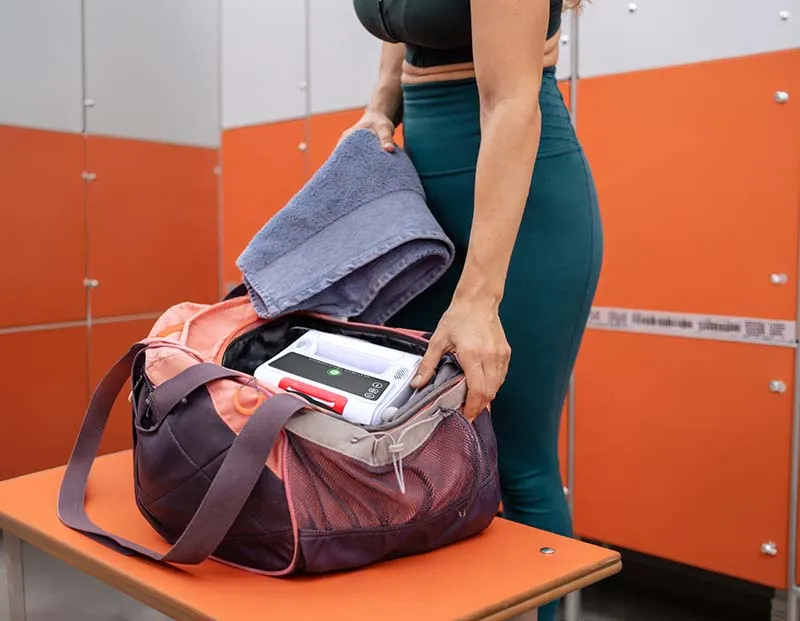
- Portable, lightweight design: A compact device is easier to position near workout areas and retrieve quickly during an emergency.
- Adult and paediatric capability: A device with adult and child modes can support facilities used by both adults and younger members.
- Automatic self-tests and readiness indicators: These features help staff identify battery, pad or device issues before the AED is needed.
- Practical battery and pad replacement: Replacement components should be easy to obtain and manage as part of routine maintenance.
- Durable construction: Resistance to dust, moisture and frequent handling may be valuable in busy fitness environments.
- ARTG inclusion: The AED should be listed on the Australian Register of Therapeutic Goods, confirming it can be legally supplied in Australia.
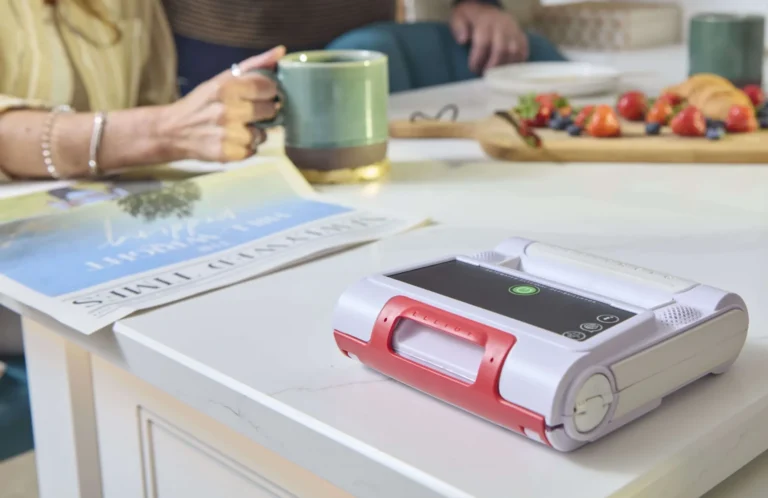
The right AED choice makes the difference between a policy on paper and a device your staff can actually use under pressure. For gyms and fitness centres, Elliot brings these priorities together in a portable, lightweight and fully automatic AED. Guided operation supports the responder during an emergency, while automatic readiness monitoring helps staff confirm that the device is ready for use.
Explore the Elliot automated external defibrillator to learn more about its features for gyms and fitness centres.
FAQS
Can an AED be used if the person is sweaty?
Yes, but the chest should be dried before applying the pads so they adhere properly. The pads must be placed firmly on bare skin in the positions shown on the device.
Can an AED be used on someone with a pacemaker?
Yes. The presence of a pacemaker or implanted defibrillator should not delay treatment. Where the device can be identified beneath the skin, the AED pad should ideally be positioned at least 8 cm away from it. [4]
What should a gym do after an AED has been used?
The incident must be documented, and the AED should be inspected before it is returned to service. Used pads must be replaced, while the battery, remaining accessories and device status should be checked in line with the manufacturer’s instructions.
Citation
- South Australia – Automated External Defibrillators (Public Access) Act 2022: https://www.legislation.sa.gov.au/_legislation-documents/lz/c/a/automated-external-defibrillators-public-access-act-2022/current/2022.27.auth.pdf
- SA Health – Automated External Defibrillators (AEDs): requirements for public buildings and facilities: https://www.sahealth.sa.gov.au/wps/wcm/connect/public+content/sa+health+internet/about+us/campaigns+and+projects/automated+external+defibrillators/requirements+for+public+buildings+and+facilities/requirements+for+public+buildings+and+facilities
- Safe Work Australia – First Aid in the Workplace: Model Code of Practice: https://www.safeworkaustralia.gov.au/system/files/documents/1908/code_of_practice_-_first_aid_in_the_workplace_0_0.pdf
- Australian and New Zealand Committee on Resuscitation (ANZCOR) – Guideline 7: Automated External Defibrillation in Basic Life Support: https://www.anzcor.org/home/basic-life-support/guideline-7-automated-external-defibrillation-in-basic-life-support/downloadpdf