





Disclaimer: All information contained herein should be independently verified by the reader and not be relied upon without such verification. An automated external defibrillator is a medical device and should only be used according to the manufacturer’s instructions. Sudden cardiac arrest is a medical occurrence, and appropriate medical advice should be sought. Always dial Triple Zero in an emergency.
Yes. An automated external defibrillator (AED) is worth considering as part of workplace emergency preparedness because sudden cardiac arrest can happen unexpectedly, including to people with no known heart condition.
A cardiac emergency at work may involve an employee, contractor, customer or visitor. If someone is unresponsive and not breathing normally, the immediate response is to call Triple Zero (000), begin CPR and use an AED as soon as one is available.
Whether your workplace is legally required to have an AED depends on where you operate and the type of premises. But compliance is only one part of the decision. The number of people on site, the distance to emergency medical assistance, workplace activities and how quickly another AED could realistically be reached are all practical considerations.
This guide looks at when AED requirements may apply, the types of workplaces that have a stronger case for having one and how to incorporate an AED into workplace emergency preparedness.
Is an AED Legally Required in Your Workplace?
There is no blanket Australia-wide requirement for workplaces to have an AED. Specific obligations can apply depending on the state or territory and the type of building or facility.
Workplace first aid arrangements are generally based on factors such as the nature of the work, workplace hazards, site size, location and the people present. [1] Employers should check the requirements of their relevant state or territory regulator. For example, South Australia has specific AED legislation. Under the Automated External Defibrillators (Public Access) Act 2022, AEDs are required in designated and prescribed buildings and facilities. [2]
Legal requirements are only one consideration. Even where an AED is not specifically required, a workplace may still choose to provide one to strengthen its emergency preparedness and improve access to defibrillation before emergency medical assistance arrives.
Which Workplaces Have a Greater Need for an AED?
Sudden cardiac arrest can occur in any workplace, but some environments have practical factors that make immediate access to an automated external defibrillator particularly worth considering.
Workplaces With Large Workforces or High Public Traffic
Offices, retail centres, hospitality venues, schools, warehouses, factories and event venues may accommodate employees alongside customers, contractors, delivery workers and visitors. A larger on-site population means more people at potential risk and a greater need for immediate access to emergency equipment.
Workplace size also affects access. An AED located elsewhere in a large building, on another floor or in a shared building may take valuable time to retrieve. Multi-storey buildings, separate work areas and large industrial sites should therefore consider how quickly emergency equipment can actually reach someone who has collapsed.
SafeWork SA recommends considering an AED where large numbers of members of the public are regularly present at the workplace. [3]
Remote or Isolated Workplaces
Workplaces farther from ambulance services may have a stronger reason to keep an AED on site.
Mines, farms, regional facilities, remote construction projects and other isolated workplaces may be farther from ambulance services than metropolitan workplaces. Field teams can face a similar issue when employees work away from a central facility or move between locations.
In these settings, relying on a nearby public AED may not be realistic. Having an AED with the team or at the worksite provides access to defibrillation while emergency services are on their way to the location.
SafeWork SA identifies potential delays in ambulance arrival as one of the circumstances in which workplaces should consider providing an AED. [3]
Physically Demanding Work Environments
Construction sites, warehouses, manufacturing facilities, gyms and similar workplaces can involve sustained physical activity and demanding working conditions.
Physical exertion should not be treated as evidence that someone will experience sudden cardiac arrest. However, physically demanding work can be one factor to consider when assessing whether an AED would be appropriate for the workplace, alongside the number and characteristics of people on site, workplace layout and access to emergency medical assistance.
For these businesses, the relevant question is whether the workplace is equipped to respond promptly if a serious cardiac emergency occurs during normal operations.
Workplaces With Electrical Hazards
Workplaces with recognised electrical hazards may have a stronger reason to consider an AED.
Electrical workers, construction crews, manufacturing facilities and industrial sites may be exposed to high-voltage equipment or other electrical risks. A severe electrical shock can disrupt the heart’s electrical activity and contribute to cardiac arrest.
SafeWork SA specifically identifies workplaces with a risk of electrocution as environments where an AED should be considered alongside other first aid equipment. [3]
An AED does not replace electrical safety controls or other first aid measures. It provides an additional response option if an electrical incident results in cardiac arrest.
Workplaces With Older or Higher-Risk Populations
The age and health profile of the people who regularly work at or visit a workplace can also be considered when assessing whether an AED should be available.
Some businesses may have an older workforce, while others regularly accommodate older customers, residents or visitors. Certain underlying cardiovascular conditions can also increase the likelihood of cardiac arrest.
This does not mean an AED should only be considered when someone is known to be at higher risk. Sudden cardiac arrest can also occur without a previously diagnosed heart condition, so workplace preparedness should not depend solely on known medical risk factors.
Best Practices for Implementing an AED in the Workplace
Having an AED on site is only useful if people can access it quickly, understand when to use it and know it is ready for an emergency. Once a workplace provides an AED, implementation should focus on accessibility, employee awareness, device readiness and integration with existing emergency procedures.
- Keep the AED visible and accessible: Store it in a clearly marked, easy-to-reach location with clear signage so employees, contractors and visitors can identify it quickly. Avoid locked or restricted areas, and for larger or multi-level workplaces, consider whether the AED can be retrieved quickly enough from all occupied parts of the site.
- Make sure employees know the AED can be used: AEDs are designed to guide trained and untrained responders through the process. The device analyses the heart rhythm and determines whether a shock is appropriate, while voice and visual prompts guide the responder through the next steps. For more detail, read Can an Untrained Person Use an AED?
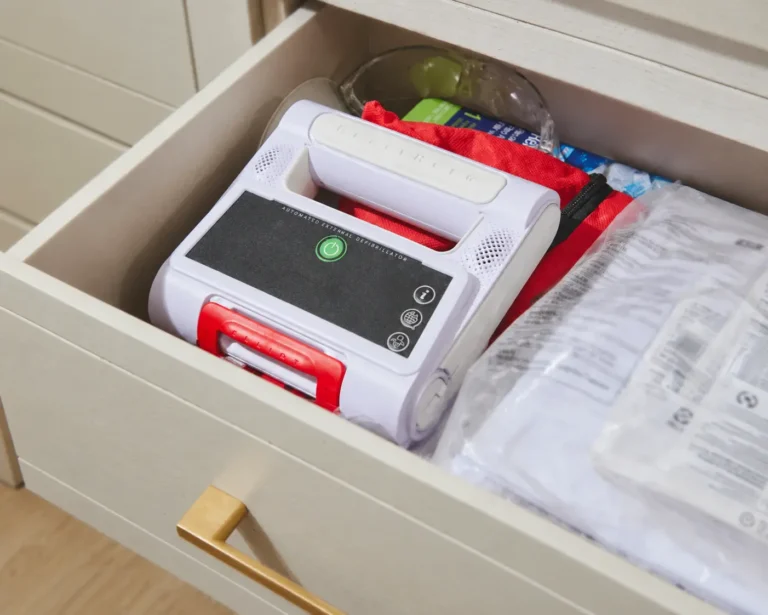
- Keep the AED ready for use: Follow the manufacturer’s maintenance and replacement requirements for pads, batteries and other components, and assign responsibility for checking readiness. Features such as automatic self-tests and alerts for battery, pad and device status can support ongoing maintenance. Elliot AED performs automatic self-tests and can provide readiness information through Bluetooth® and LTE connectivity.
- Include the AED in the workplace emergency plan: Employees should know how the AED fits into the response if someone is unresponsive and not breathing normally, including calling Triple Zero (000), starting CPR, retrieving the AED and helping emergency services reach the person. The AED should be part of broader first aid procedures rather than a standalone response. For more detail, read CPR and AED Together: How They Work as a Team in an Emergency.
Having an AED can strengthen workplace preparedness by making defibrillation available before emergency services arrive. The decision should not be based on legal requirements alone. Consider how many people use the workplace, whether members of the public regularly attend, the location and layout of the site, recognised workplace hazards and how quickly an AED could otherwise be reached.
Once an AED is provided, accessibility and ongoing readiness become just as important as ownership itself.
Elliot is a portable, lightweight and fully automatic AED designed to support straightforward use in workplace and other everyday environments. Its guided operation and device-readiness monitoring can help businesses keep emergency defibrillation accessible and prepared for use.
Explore the Elliot AED and its features for workplace emergency preparedness.
FAQs
How many AEDs should a workplace have?
There is no single number that suits every workplace. The appropriate number depends on factors such as the size and layout of the site, the number of buildings or floors, where people are usually located and how quickly an AED can be retrieved. A large or dispersed workplace may need more than one device to maintain practical access across the site.
What should a workplace do after an AED has been used?
The AED should be checked and returned to a ready state according to the manufacturer’s instructions. Used pads generally need to be replaced, and the device and battery should be checked before the device is returned to its location. Any workplace incident-reporting or emergency-response procedures should also be followed.
Can a workplace AED be moved between different work sites?
A portable AED like Elliot can potentially be moved between sites, provided it is stored and transported according to the manufacturer’s requirements and remains readily accessible when needed. Businesses with mobile or field-based teams should also consider whether moving one device between locations could leave another workplace without timely AED access.
Citation
- Safe Work Australia – Know your WHS duties: https://www.safeworkaustralia.gov.au/duties-tool/construction/duties-information/first-aid
- South Australia – Automated External Defibrillators (Public Access) Act 2022: https://www.legislation.sa.gov.au/\_legislation-documents/lz/c/a/automated-external-defibrillators-public-access-act-2022/current/2022.27.auth.pdf
- Safe Work SA – First Aid: https://www.safework.sa.gov.au/workers/your-health-and-safety-at-work/first-aid