




Disclaimer: All information contained herein should be independently verified by the reader and not be relied upon without such verification. An automated external defibrillator is a medical device and should only be used according to the manufacturer’s instructions. Sudden cardiac arrest is a medical occurrence, and appropriate medical advice should be sought. Always dial Triple Zero in an emergency.
At a glance
- If someone is unresponsive and not breathing normally, treat it as cardiac arrest and act immediately.
- Call Triple Zero (000) immediately and begin CPR without waiting for someone more experienced.
- Retrieve the nearest AED (automated external defibrillator) where possible, turn it on and follow its instructions.
- An AED analyses the heart rhythm and only advises or delivers a shock when a shockable rhythm is detected.
- Resume CPR when prompted and continue following the AED and emergency operator’s instructions until paramedics take over.
When sudden cardiac arrest occurs, the first person able to help is often a family member, colleague, teammate or stranger rather than a healthcare professional. The person may collapse, become unresponsive and stop breathing normally, leaving those nearby to act before paramedics arrive.
In those first few minutes, a bystander can recognise the signs, call Triple Zero (000), begin CPR and use an automated external defibrillator (AED) as soon as one is available. CPR helps maintain blood flow, while the AED analyses the heart rhythm and determines whether a shock is needed.
Bystanders are not expected to diagnose the cause of the collapse or make clinical decisions. The Triple Zero operator and AED prompts guide the process. What bystanders need to do is initiate the emergency response.
This article explains what bystanders should do from the moment someone collapses until emergency services arrive, and how prompt action can improve someone’s chance of survival.
Recognise the Signs of Sudden Cardiac Arrest
Sudden cardiac arrest often strikes without warning. Before touching the person, quickly check for immediate danger, such as traffic, fire, electricity or moving machinery. If it is safe to help, speak to them and gently squeeze their shoulders to see whether they respond. If there is no response, check whether they are breathing normally.
Occasional gasps, noisy breaths or irregular breathing should not be mistaken for normal breathing. If the person is unresponsive and not breathing normally, treat the situation as suspected cardiac arrest and act immediately. Do not spend time checking for a pulse or trying to determine whether fainting, a seizure, a heart attack or another condition caused the collapse.
For a clearer explanation of how cardiac arrest differs from a heart attack, read our guide to the difference between sudden cardiac arrest and a heart attack.
Call Triple Zero Immediately
Once you have identified the signs of cardiac arrest, call Triple Zero (000) immediately and ask for an ambulance. Put the phone on speaker, where practical, so you can keep both hands free to begin CPR.
Clearly state your location to the operator and explain that the person is unresponsive and not breathing normally. Stay on the line; the operator will guide you on how to respond while emergency services are on the way.
Start CPR Without Delay
Begin CPR as soon as you’ve confirmed the person is unresponsive and not breathing normally. Do not wait for the operator to tell you to start. Place the heel of one hand in the centre of the person’s chest, place your other hand on top and begin firm, regular compressions. Follow the operator’s guidance on the correct rate and technique.
CPR helps keep blood moving to the brain and other vital organs when the heart is no longer pumping effectively. It does not correct the abnormal heart rhythm that may have caused the cardiac arrest, but it can support the person until an automated external defibrillator (AED) is available.
Do not wait for someone with more training before starting CPR. Immediate CPR is more important than performing every step perfectly.
Use an AED as Soon as It Is Available
While CPR keeps blood circulating, an automated external defibrillator can assess and treat certain abnormal heart rhythms that CPR cannot correct. The AED analyses the heart rhythm automatically and determines whether a shock is appropriate, so the bystander only needs to follow its prompts. If no shockable rhythm is detected, the device will not advise or deliver a shock.
If other people are nearby, give each person a clear role. Ask one person to retrieve the nearest AED while CPR continues, and another to direct paramedics to the location if it is difficult to find. This gets the AED to the person’s side without unnecessarily interrupting compressions.
Once the AED arrives:
- Bring it to the person rather than moving them unnecessarily.
- If another bystander is available, have them prepare the device while CPR continues. If you are on your own, pause compressions briefly to do this yourself, then resume the CPR.
- Turn on the AED, expose the person’s chest and place the pads directly on bare skin in the positions shown on the device.
- Follow the voice prompts, visual instructions and pad-placement diagrams.
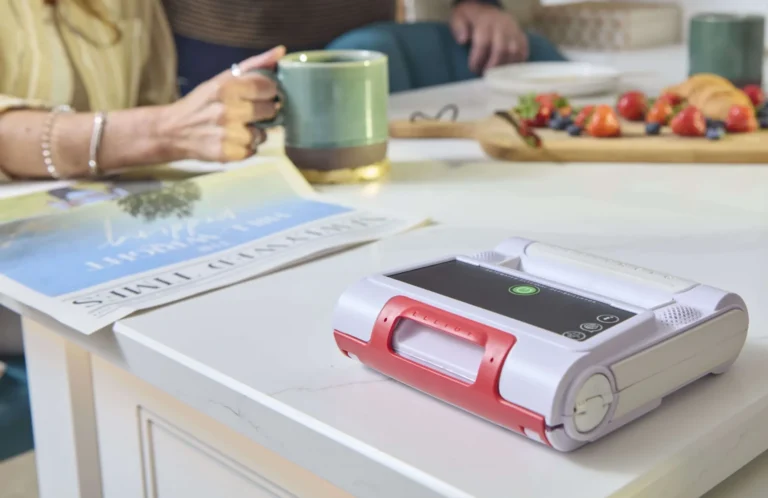
Some AEDs also include features that reduce the number of steps required during use. Elliot defibrillator, for example, comes with pre-connected pads, voice and visual prompts and fully automatic operation to support the responder through the process.
For a detailed explanation of the process, read our guide on how to use an AED.
Once the pads are attached, the AED will instruct everyone to stand clear while it analyses the heart rhythm. Stop CPR at this point and make sure no one is touching or moving the person, as movement can interfere with the reading.
What happens next depends on the type of AED. A semi-automatic device will tell the responder to press the shock button if a shockable rhythm is detected. A fully automatic AED removes that step by warning everyone to stand clear before delivering the shock itself.
After the analysis or shock, continue following the AED prompts. The device will tell you when to resume CPR and what to do next.
Resume CPR and Continue Until Emergency Services Take Over
After a shock is delivered, or if the AED advises that no shock is needed, resume CPR immediately when prompted. A no-shock decision does not mean the emergency is over. It means the device has not detected a rhythm that can be treated with a shock at that time.
Leave the pads attached and continue following the AED and Triple Zero operator’s instructions. The device will check the heart rhythm again after another CPR cycle and may advise or deliver a shock if the rhythm changes.
Continue CPR and AED use until paramedics arrive and take over. If the person begins breathing normally or shows clear signs of recovery, stop CPR and follow the Triple Zero operator’s guidance while continuing to monitor them.
What you do in the first few minutes can genuinely change the outcome for someone in cardiac arrest. The priority is simple: recognise the signs, call Triple Zero, begin CPR and use an AED without unnecessary delay.
A quick response also depends on whether an AED can be reached easily and used confidently by the person nearby. Elliot AED is lightweight, portable and built to be that kind of device, one a bystander can pick up and trust, without needing to have used it before.
Explore Elliot AED and be better prepared to respond appropriately during a cardiac emergency when the first few minutes count.
FAQs
Can sudden cardiac arrest affect someone who appears fit and healthy?
Yes. Sudden cardiac arrest can affect people of different ages and fitness levels, including those with no known heart condition. In some cases, the cause may be an undiagnosed heart condition or another medical event.
Can a bystander use an AED without formal training?
Yes. AEDs are designed to guide non-medical users through the response with voice prompts, visual instructions and pad-placement diagrams. Formal training can build confidence, but a bystander should not delay using an available AED while waiting for someone more experienced. For more information, read our guide on whether an untrained person can use an AED.
What should I do if no AED is nearby?
Call Triple Zero (000), begin CPR and follow the operator’s instructions. If you are alone, do not leave the person or stop compressions to search for an AED. Continue CPR until someone else brings one, the person begins breathing normally or emergency services take over.