



Disclaimer: All information contained herein should be independently verified by the reader and not be relied upon without such verification. An automated external defibrillator is a medical device and should only be used according to the manufacturer’s instructions. Sudden cardiac arrest is a medical occurrence, and appropriate medical advice should be sought. Always dial Triple Zero in an emergency.
At a glance
- A home AED is not necessary for every household, but it may be worth considering where rapid access to a public defibrillator isn’t guaranteed.
- Households with known cardiac risk or remote locations, or frequently travelling families may benefit from having an AED nearby.
- A suitable home AED should be listed on the TGA’s ARTG, easy to operate, suitable for adults and children, portable and simple to keep ready.
- A home AED works best with accessible storage, CPR knowledge, regular readiness checks and a proper plan for emergency response.
More than 32,000 people experience cardiac arrest in Australia each year. Around 80% of cases occur at home, and only about one in ten people survives an out-of-hospital cardiac arrest. [1]
Because most incidents happen in private residences, public defibrillators in shopping centres, workplaces, gyms and community facilities may not be accessible quickly enough. Keeping an AED at home can reduce the time to defibrillation during a cardiac emergency.
An AED (automated external defibrillator) is a portable device that analyses the heart’s rhythm and advises or delivers a shock only when it detects a shockable rhythm. When CPR and AED are used within three to five minutes, survival rates can increase to 60–70%, although no intervention guarantees survival. [1]
This article examines which households may consider an AED, what to look for, where to keep it and how it fits alongside other emergency responses like Triple Zero and CPR.
Benefits of having an AED at home
Keeping an AED at home can support a faster, more effective response to cardiac arrest while paramedics are on the way. It cannot prevent cardiac arrest or guarantee survival, but it can provide earlier access to defibrillation when a public device is too far away or unavailable.
A home AED also guides the person responding. Once the pads are attached, the device analyses the heart rhythm, determines whether a shock is appropriate and provides voice and visual prompts for each stage. The responder does not need to interpret the rhythm or decide whether a shock should be delivered. The device does the decision-making for you.
Who Should Consider a Home AED?
Owning a home AED is not only beneficial for households with a diagnosed heart condition. Certain health, location and lifestyle factors may make faster access to a defibrillator more valuable for some households.
- Households with known cardiac risk: Families may consider a home AED if someone has a diagnosed heart condition, a history of heart attack, an inherited rhythm disorder or another recognised risk factor. An AED should complement ongoing medical care and prescribed treatment, not replace them.
- Rural and remote households: Properties located far from ambulance stations, hospitals or public-access AEDs may face longer delays before emergency services arrive. Road conditions, property access and travel distance can also affect emergency response times and the need for a home AED.
- Families seeking portable AED access: Households that regularly travel, camp, hike or stay at holiday properties may want access to an AED beyond their primary residence. A compact, lightweight device can be easier to move between suitable locations, provided it is stored and transported according to the manufacturer’s requirements.
- Households focused on emergency preparedness: Families that already maintain first aid supplies, emergency contacts and response plans may consider adding an AED to extend their preparedness to sudden cardiac arrest.
These circumstances do not mean that every such household needs an AED. They can, however, help families assess whether faster access to defibrillation would be practical for their situation.
What to Look for When Buying a Home AED
A home AED should be easy to operate, practical to maintain and suitable for the people who may need it. When comparing devices, focus on the features that support confident use and long-term readiness.
- Listed on the TGA’s ARTG: Confirm that the AED is listed on the Therapeutic Goods Administration’s Australian Register of Therapeutic Goods and can be legally supplied and used in Australia.
- Clear, guided operation: Look for simple activation, audible instructions, visual prompts and pads that can be accessed without complicated setup. These features can help household responders follow each step correctly even under pressure.
- Fully automatic or semi-automatic operation: A semi-automatic AED asks the responder to press a button when a shock is advised. A fully automatic model delivers the shock itself after analysing the rhythm and warning everyone to stand clear.
- Adult and child suitability: Check whether the device includes a paediatric mode, child settings or suitable pads for children. A single device that can adjust its operation for adults and children may be more practical for a family home.
- Readiness and maintenance: Automatic self-tests and clear alerts for battery condition, pad expiry and device faults make it easier to confirm that the AED is ready. Also consider battery availability, pad shelf life and how easily replacement components can be ordered.
- Portable design: Weight, size and carrying convenience are relevant when the AED may be moved between the house, car, holiday property or outdoor activities.
- Warranty and ongoing support: Review the warranty period, the process for lodging a claim, distributor support and the expected replacement costs for batteries and pads.
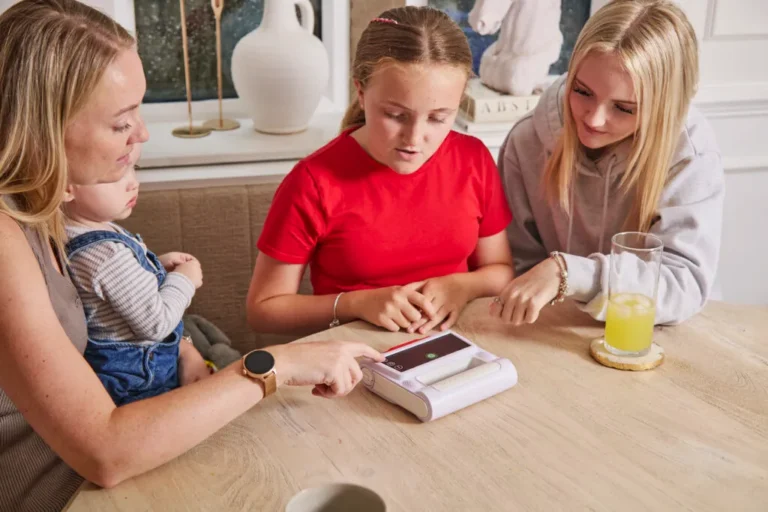
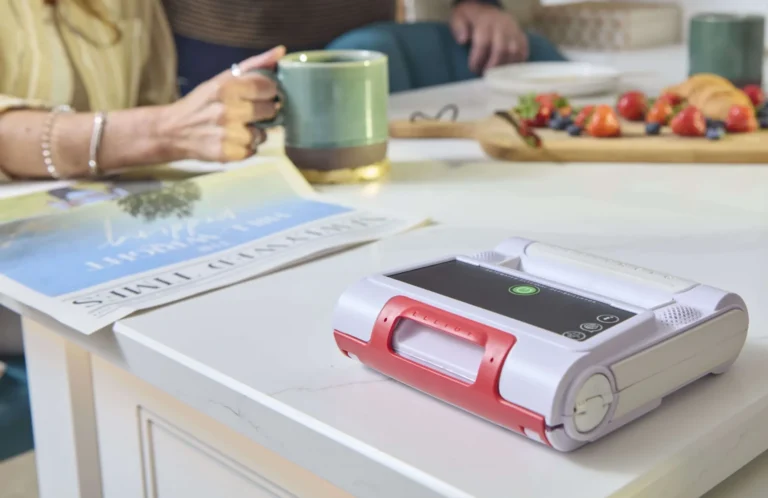
Elliot AED brings these home-use considerations together in a portable, lightweight design. It is listed on the TGA’s ARTG. Fully automatic operation, clear voice and visual prompts, pre-connected pads and dedicated adult and child modes support straightforward use during an emergency.
Elliot also performs automatic self-tests and provides battery, pad and device status alerts to help owners monitor readiness. It uses four readily available CR123A batteries and comes with a six-year warranty, supporting long-term, low-maintenance ownership.
Where to Keep an AED at Home
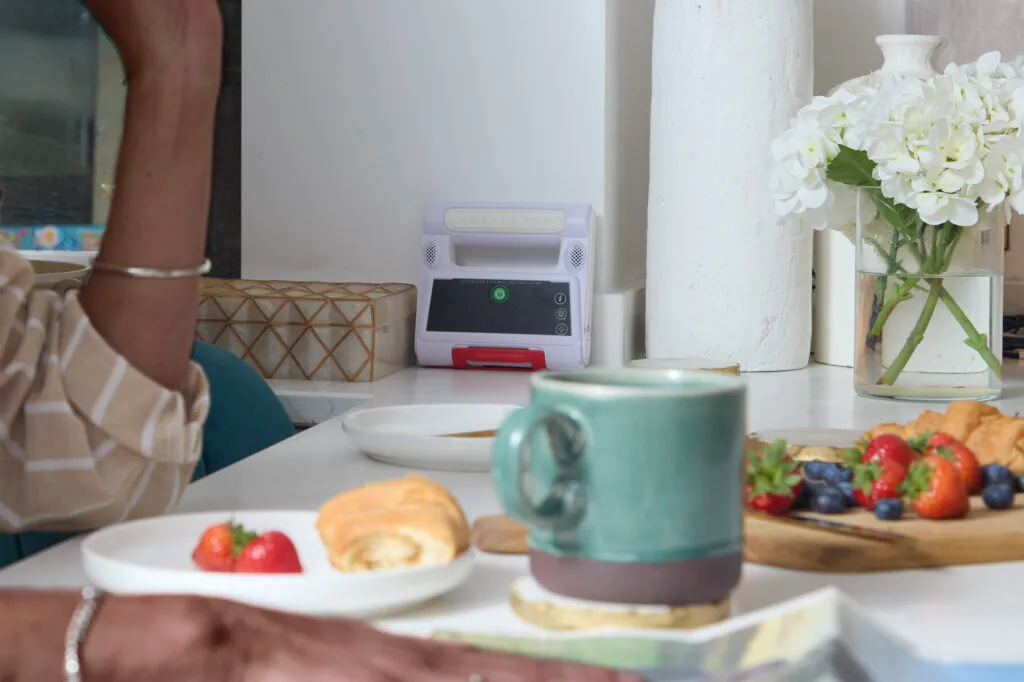
An AED should be stored where it can be found and retrieved quickly. A central, visible location near the main living areas is usually more practical than a bedroom cupboard, garage shelf or locked cabinet. Everyone in the household should know where the device is kept, and regular visitors or carers should also be able to identify it in an emergency.
Accessibility should be considered across the entire property. In a large or multi-storey home, consider how long it would take to reach the AED from bedrooms, outdoor areas and other frequently used spaces. A clearly marked wall bracket, cabinet or dedicated emergency equipment area can make the device easier to locate without restricting access.
The storage environment also needs to meet the manufacturer’s requirements. Keep the AED protected from avoidable damage, moisture and unsuitable temperatures, and out of unsupervised reach of children and pets. Batteries should remain installed and the pads connected so the device is ready for use at any time.
Check the status indicator periodically and respond to any battery, pad or fault alerts. The best storage location is not simply where the AED fits, but where it remains visible, protected and accessible.
How Does a Home AED Fit Into the Cardiac Arrest Response?
A home AED is only one part of the response to suspected cardiac arrest. It does not replace calling emergency services or performing CPR. If someone is unresponsive and not breathing normally, call Triple Zero (000) immediately and begin CPR.
If another person is present, ask them to retrieve and turn on the AED while you continue CPR. If you are alone, pause CPR briefly to retrieve the AED yourself, then resume as soon as it’s ready to use. Expose the person’s chest, apply the pads as shown and follow the device prompts. Stop touching the person when instructed, so the AED can analyse the heart rhythm and advise or deliver a shock if required. Resume CPR when prompted and continue following the AED and emergency operator’s instructions until paramedics take over.
For a detailed walkthrough of device activation, pad placement, rhythm analysis and shock delivery, read “How to Use an AED: What Actually Happens When You Turn It On?”
How to Make a Home AED Part of Your Emergency Plan
Buying a home AED is only the first step. The household should also understand the device, maintain its readiness and include it in a simple emergency plan.
- Complete the initial setup: Follow the manufacturer’s instructions, confirm the batteries and pads are installed correctly and check that the device indicates it is ready.
- Become familiar with the device: Household members should know how to activate the AED, access the pads and select adult or child mode where applicable. They do not need to memorise the full process because the device guides each step.
- Consider CPR training: An AED does not perform CPR. Training can help household members recognise cardiac arrest, begin compressions promptly and respond with greater confidence while following the AED and Triple Zero operator’s instructions.
- Discuss basic response roles: Where several people are present, consider who may call Triple Zero, begin CPR and retrieve the AED. Discussing these roles beforehand can support a more organised response.
- Assign responsibility for device readiness: Nominate someone to monitor status alerts and maintain records of battery and pad replacement dates, warranty details and other maintenance requirements.
- Understand post-use requirements: Pads are single-use, and batteries or other components may need replacement after an emergency. Follow the manufacturer’s instructions before returning the AED to service.
Deciding whether to keep an AED at home comes down to access, household circumstances and long-term readiness. Families with known cardiac risk, limited access to public defibrillators or frequent travel away from fixed AED locations are often the ones who benefit most from keeping one on hand.
Getting the most from a home AED means storing it somewhere accessible, checking it regularly and making sure everyone in the household knows how to use it properly along with CPR.
For households considering a portable home defibrillator, explore Elliot AED, designed for home and personal use.
FAQs
Do I need training before using an AED?
No. AEDs are designed to guide the responder with voice and visual prompts, and the device itself determines whether a shock is required. Formal training can build confidence, but it is not required to act in an emergency. For more detail, read “Can an Untrained Person Use an AED?”
Can a home AED be used on someone with a pacemaker?
Yes. An AED can still be used on someone with a pacemaker or implanted defibrillator. Look for a raised area or scar that may indicate the implant. Do not place a pad directly over it; position the pad at least 8 cm away where possible and follow the pad-placement diagrams. [2]
Citation
- Heart Foundation – Cardiac Arrest https://www.heartfoundation.org.au/heart-of-the-nation/cardiac-arrest
- Australian and New Zealand Committee on Resuscitation (ANZCOR) – Guideline 7: Automated External Defibrillation in Basic Life Support: https://www.anzcor.org/home/basic-life-support/guideline-7-automated-external-defibrillation-in-basic-life-support/downloadpdf